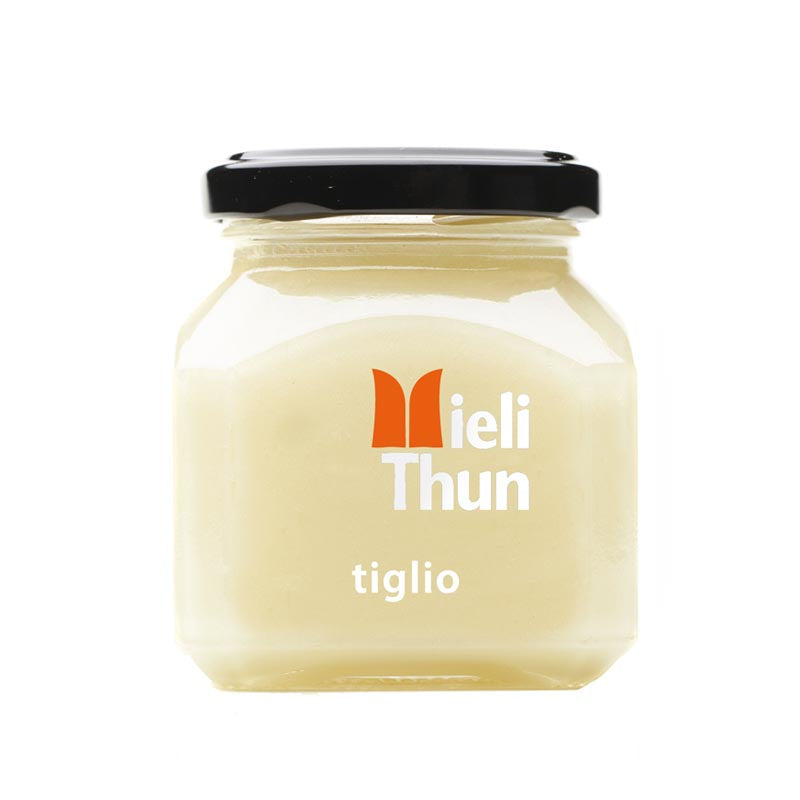
Honey - Linden Honey - Thun Honey
Honey - Linden Honey - Thun Honey
Linden Honey:
Honey with a bold aromatic personality, produced from Tilia cordata blooms. It crystallizes naturally due to its high glucose content, a hallmark of purity and lack of heat treatment. On the nose, it offers balsamic and mentholated aromas; on the palate, it is fresh and herbaceous, with a balanced sweetness.
Recommended for herbal teas, hot milk, and pairings with fresh cheeses and pecorino cheeses.
Main features
• Origin: Lime blossoms
• Color: light amber
• Taste: balsamic, mentholated, fresh
• Physical state: fine crystallized or creamy
The Plant:
Each monofloral honey comes from a specific plant, with its own flowering cycle, natural habitat, and unique nectar composition. Knowing the plant helps us understand the aromas, colors, and structure of honey, because nectar is influenced by soil, climate, altitude, and surrounding biodiversity.
Linden (Tilia cordata / Tilia platyphyllos)
A long-lived tree, often centuries old, found in woodlands and tree-lined avenues. It blooms in June-July with pale yellow flowers rich in essential oils.
Linden nectar contains aromatic compounds reminiscent of mint and balsamic notes: it is precisely these precursors that define the characteristic profile of honey.

Thun Honey:
Mieli Thun is one of the most respected beekeeping companies in Italy, founded in Trentino and specializing in the production of pure monofloral honeys. The company practices nomadic beekeeping , moving its hives to over sixty selected sites throughout Italy to monitor the blooms at their optimal time.
Each honey comes from a single, recognizable bloom , harvested without heat treatment, preserving its aromas, enzymes, and botanical identity. This approach allows for honeys that faithfully reflect the landscape, season, and plant from which they originate.
The company's philosophy is based on three principles:
• Pure ingredient , unpasteurized and unrefined.
• Territoriality , with collections in selected and uncontaminated places.
• Transparency , from the choice of sites to honey extraction and maturation.
The result is a collection of honeys that does not seek standardization, but enhances biodiversity and the unique character of each vintage and each territory .
Couldn't load pickup availability