
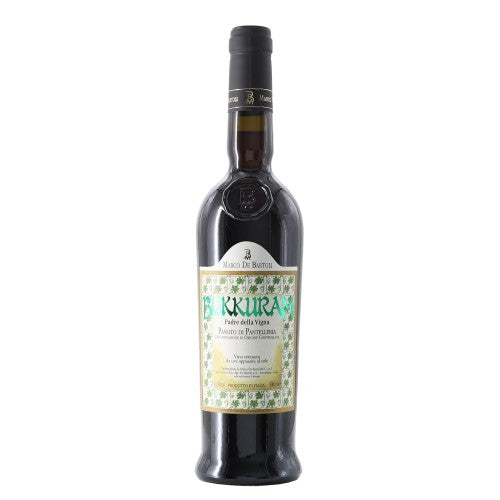
Marco de Bartoli - “Bukkuram” Passito of Pantelleria 2019
Marco de Bartoli - “Bukkuram” Passito of Pantelleria 2019
Made from Zibibbo grapes from vines between 30 and 50 years of age on average, grown as saplings and kept at a very low yield, Passito Bukkuram (a term that identifies a real cru, a district in Sicily, for the cultivation of Zibibbo grapes suitable for becoming a passito), is made from Zibibbo grapes which are 50% left to dry on the vine and 50% left to dry on racks in the sun.
Fermentation is spontaneous and when it is sufficiently advanced the dried grapes are added and left to mature for at least 3 months.
This is followed by 30 months of refinement in barrique and 6 months in steel before bottling.
A full, welcoming sip, supported by an imposing saline base.
When we talk about Passito di Pantelleria we also talk about a bit of history. Just think that the first mentions of this wine date back to the ancient Greeks. And when we talk about the history of wine in Sicily we cannot fail to mention Marco de Bartoli, an identity of singular importance in the history of Marsala and the Sicilian wine scene in general.
The winery has only one soul, that of the De Bartoli family, divided between two places, so as to produce native and identifying wines in the most suitable places.
A winery in Pantelleria, in Contrada Bukkuram, which in Arabic means "father of the vineyard", and one in Marsala, in Contrada Samperi. I leave you here the words of someone who knew and was able to describe with words that move me every time I read them, the figure of Marco De Bartoli:
Excerpt from: Luigi Veronelli and Nichi Stefi (1986), The historical winemakers I, Mediolanum Editori Associati, Milan
He has the sunny impetuosity of his land: when you meet him he would like to tell you everything in a few minutes, and make you taste everything, explain his joy and satisfaction for positive reviews of his wine and at the same time he would like to express his anger at how the wine of the South is considered and he becomes a meridionalist, and then, suddenly, he takes offense at the men of his own land who have transformed the name Marsala, for decades, into an almost vulgar word.
He has tears in his eyes when he speaks of the degradation of his Sicily, he lights up with fury; but he immediately relaxes, in his thousand projects when the glass approaches his lips.
The “Vecchio Samperi” is a wine that has nothing to compare it to. Unique, arrogant, powerful, bold, but without disharmony, unrepeatable. And it is this wine – fortunately it could not be called Marsala because it is not fortified as the Marsala Vergine specification requires – that brought it to the scene of the greats where it immediately had the role of protagonist.
The company is twelve kilometers from Marsala, in that land of Sicily that is great in all its manifestations, for better or for worse; a hard land of hard men, of families settled on the territory. Marco De Bartoli has the Gascon signs of the will to win on all fronts and he has won, with the tenacious, stubborn conviction of being right, and to demonstrate it he speaks a lot as is customary in Sicily, not to tell about himself, but to allow me to drink: there is his greatest proof.
Today he has a family he is proud of: Renato and Sebastiano, his sons, are almost grown up and Josephine, the youngest, is named after her grandmother of French origin. He is also proud of his origins, as his father was already involved in wine. He has renovated the cellar not only with taste and humility, but with the pride and awareness of having succeeded in doing what he hoped: his wines have multiplied and – in addition to the Vecchio Samperi, which exists in 10 – 20 – 30 and 40 year versions (of the latest series only 250 bottles, without price, for God's privileged few) – he produces: the twenty year old Marsala Superiore; the Josephine Doré (the young part of the Vecchio Samperi which is, obviously, aged with the soleras method); the easier Inzolia; the Josephine Rouge, a sweet red from Pignatello grapes; and finally the Moscato Passito di Pantelleria, from Moscato grapes coming from the Bukkuram cru, which in Arabic means “father of the vineyard” to indicate the best place.
When you hang out with him you discover that Marco De Bartoli, powerful and kind, with curly hair, cut very short, smiles and you know that he knows what the values are, in life as in grapes.
Couldn't load pickup availability
